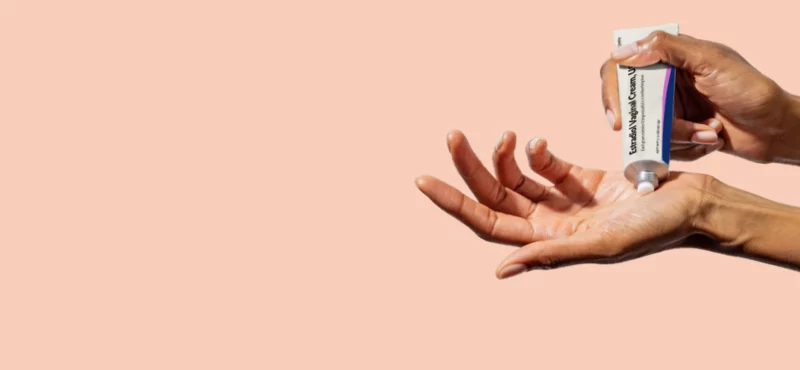


There’s no shortage of treatments promising to rejuvenate facial skin. And vaginal estrogen for the face might sound like the strangest one yet.
You might be wondering how we got here. And if there is any benefit to putting a dab of estrogen cream on small areas of your face to help with wrinkles or aging.
Quick takeaway:
- Because vaginal estrogen has been proven to restore thin, dry vaginal skin, some doctors are starting to prescribe that same treatment to help minimize wrinkles and aging of the face, neck, and hands.
- If you want a topical estrogen for your face, the most commonly prescribed option is estradiol vaginal cream 0.01%. Like any estrogen treatment, this is available by prescription only.
- Vaginal estrogen isn’t indicated for facial use, so any prescription for facial use is considered unproven or "off-label".
- The potential anti-aging and cosmetic benefits are promising. But topical estrogen for cosmetic use hasn’t been well studied. The benefits and drawbacks should be reviewed with a qualified doctor, and we’ll cover those below.
First, What Does Estrogen Do for Skin?
Estrogen is a hormone made mainly by the ovaries. It does a lot of things in the body, including keeping skin healthy.
Declining estrogen can cause classic menopause symptoms like hot flashes and night sweats. It also affects your skin, including vaginal tissue:[1]
- Vaginal skin gets thinner and drier
- Tissue loses elasticity and becomes more fragile
- Discomfort, irritation, and dryness become common
And it’s not just vaginal skin. The same changes happen on your face, neck, and hands:
- Skin gets thinner and drier
- Collagen breaks down (the protein that keeps skin firm and bouncy)
- Hyaluronic acid, which keeps skin hydrated, goes down
In the first five years of menopause alone, women can lose 30% of their collagen. Yes, 30%.[2]
What Happens When You Apply Estrogen to the Face?
When estrogen is applied topically to the face, some signs of aging may reverse. Topical estrogen applied to the face has been associated with improvements in: [3], [4], [5], [6]
- Collagen synthesis
- Skin thickness
- Skin hydration
- Elasticity
That said, the existing research consists of a handful of small, short-term studies on postmenopausal women. They’re considered preliminary, meaning we can’t draw broad conclusions about long-term safety or effectiveness.
Where Do You Get Estrogen Cream and How Is It Used?
Doctors have prescribed vaginal estrogen for decades to treat the effects of menopause on vaginal tissue, including dryness, irritation, and discomfort. With consistent use, thin, dry, and fragile skin can regain moisture, elasticity, and softness. It's a wonderful treatment for what's known as vaginal atrophy or the genitourinary syndrome of menopause (GSM).
What makes it work so well is the concept of local application. A small amount of estrogen is applied directly to the area that needs it, and it works right there without much getting into the rest of the body.[7]
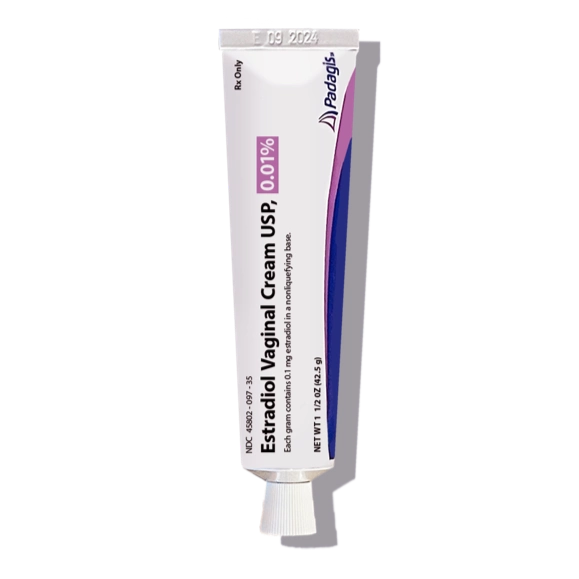
- Active ingredient: Estradiol 0.01%
- Use: Prescribed for vaginal atrophy and GSM for decades; some doctors now prescribe off-label for the face, neck, and hands.
- Price: $39 for a 2–3 month supply
There are no FDA-approved estrogen creams for facial or cosmetic use, so doctors tend to work with what’s available and well-studied. Most commonly prescribed is estradiol vaginal cream 0.01%. It’s the same product that’s used vaginally, just applied in a different area like the face, neck, or hands.
Some compounding pharmacies now market prescription estrogen creams specifically for the face, with varying concentrations of estradiol or estriol. But compounded products aren’t tested or regulated the way FDA-approved products are, and there can be instability and batch-to-batch variability in the formulas, so it’s even harder to guess how safe this might be.
Is Estrogen Cream Safe for the Face?
Many of us are rightfully concerned about using topical estrogen on our face. Especially if there are no long term studies about safety or absorption throughout the body.
Since no one has studied this directly, vaginal estrogen research is the closest thing we have to a safety guide. Here’s what it tells us.
Skin irritation can happen anytime you apply prescription treatment to your skin. Side effects of topical estrogen on the face could include vascularity or unsightly small red spots called angiomas. And for women who get melasma (uneven skin pigmentation), it’s possible that estrogen could make melasma worse.
Systemic absorption seems low. While estrogen can do wonderful things for your body, there is a concern around systemic absorption into the bloodstream which can lead to serious side effects. Vaginal estrogen studies have shown that very little gets systemically absorbed.[7] That’s why some dermatologists might conclude that if you are applying estrogen to a mucosal area like the vaginal skin and it’s not being systemically absorbed, then you are probably fine with applying it to your face or other small areas like the neck and hands. But this hasn’t been directly confirmed with scientific studies.
Breast cancer risk doesn’t appear to increase with vaginal estrogen, even in women who’ve had breast cancer. It’s a general consensus among gynecologists and oncologists that women who have a history of breast cancer can safely use vaginal estrogen.[8], [9] However it’s important to note that this is a quality of life issue. Oftentimes when women undergo therapy for breast cancer, they can experience significant vaginal problems like atrophy, pain, discomfort, or UTIs. So the benefits of using vaginal estrogen far outweigh a small risk of breast cancer. Whether that same safety applies to cosmetic use on the face is less clear. Women with a history of breast cancer should talk directly with their oncologist before trying this.
Uterine cancer risk isn’t shown to increase with vaginal estrogen use. Women using systemic estrogen typically need to add a progestin to protect the uterus, but women using estrogen intravaginally don’t absorb enough to raise that risk.[10] Therefore, a progestin is generally not needed when using vaginal estrogen. The same reasoning likely applies to small-area cosmetic use, but is not confirmed.
Blood clots aren’t generally a concern with any form of topical estrogen – including vaginal estrogen or systemic estrogen patches. That risk is tied to estrogen taken by mouth, which passes through the liver. Topical estrogen bypasses that.[7] Whether this applies to topical estrogen for the face remains unstudied.
Already on HRT? Experts generally agree there’s still added benefit to using vaginal estrogen if vaginal and urinary symptoms persist, even if systemic hormones (HRT) are being taken. Vaginal estrogen is not significantly absorbed throughout the body, so vaginal estrogen and systemic hormone therapy can be taken at the same time. If you want to add topical estrogen for your face to your HRT regimen, a qualified doctor can help you factor that into your overall care plan.
The Bottom Line
Estrogen can be good for skin health. That much is clear. And the idea of using it topically in small amounts on specific areas like the face and neck is an educated guess based on decades of vaginal estrogen research.
On the one hand, low-dose topical estrogen for vaginal use is well-studied and a safe and effective treatment for most women. On the other hand, topical estrogen for the face is not well studied, at least not yet. And side effects like irritation, angiomas, or melasma might make problems worse.
In any case, vaginal estrogen is one of the safest tools in menopause care, as long as you're using it for what it was actually studied for. With minimal risks, minimal systemic absorption, and decades of research, vaginal estrogen is a safe and effective treatment for women facing vaginal atrophy or GSM. For more information, browse our vaginal estrogen treatments, create your free menopause toolkit, or learn about our easy online consult and support from our board-certified doctors.