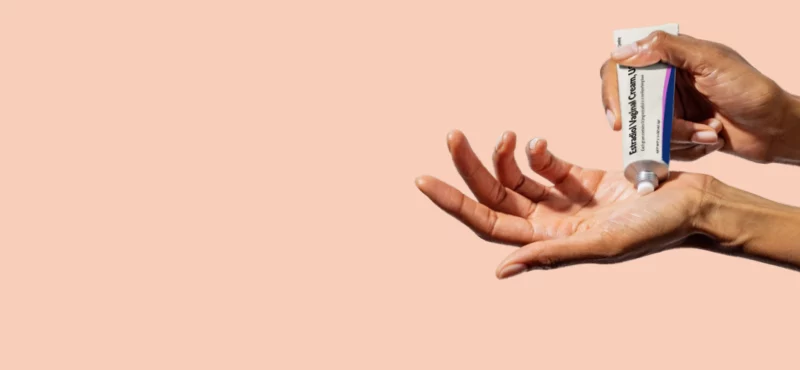
Treatment for vaginal dryness, painful sex, frequent UTIs, and urgency.
Treatment for vaginal dryness, painful sex, frequent UTIs, and urgency.


Most women are in the dark about the vaginal and bladder changes that happen with menopause. As estrogen declines, vaginal dryness, UTIs, and urinary urgency and leaks become more common. It's what's known as the genitourinary syndrome of menopause, or GSM. Left untreated, GSM tends to get worse over time. And this is why so many women end up juggling endless vaginal moisturizers, panty liners, or antibiotics.
Managing your daily comfort doesn't have to be an uphill battle. Instead, there's an easy and simple solution. At Interlude we offer a range of vaginal estrogen treatments. Choose from FDA-approved generic estradiol vaginal cream, no-mess estradiol vaginal inserts, or our custom-compounded Soothing Estradiol Cream. Just complete a quick online consult and we'll deliver to your door.


Vaginal estrogen delivers a low dose of estrogen directly to the tissue in the vaginal area, helping restore moisture, elasticity, and comfort.
Data from the Women's Health Initiative Observational Study showed that for women who use vaginal estrogen, there is no increased risk of invasive breast cancer, colorectal cancer, endometrial cancer, stroke, or blood clots.
It's confusing because the boxed safety information for vaginal estrogen shows a black box warning that there is an increased risk of these side effects. However, women's health groups have long argued these warnings do not apply to low-dose vaginal estrogen.
It's reassuring that the Menopause Society agrees with a recent FDA decision to remove the black box warning from low-dose vaginal estrogen, calling it a safe and effective therapy.
For the estradiol vaginal cream and estradiol vaginal inserts, the common dose is to apply daily for two weeks. After that, some progress is usually noticed and the next step is to taper to twice weekly. Always follow the instructions from your prescribing physician. As part of your online consult at Interlude, you'll receive specific instructions with your prescription. You can also message your prescribing physician with any questions.
Vaginal estrogen can be applied internally or externally. The estradiol vaginal cream comes with a reusable applicator for internal use, but it's common to use a fingertip to apply about a blueberry-sized amount, rubbing it in internally and externally around the vestibule (the opening of the vagina). Your doctor will give you specific instructions with your prescription.
Vaginal estrogen takes a few weeks to a few months to work, and consistency is key. If you're not seeing the results you expected, you can message your doctor through your secure Interlude account and they'll help figure things out.
No. Vaginal estrogen is very low dose, acts locally where it's applied, and isn't absorbed significantly throughout the body. According to The Menopause Society, a progestogen is not recommended for low-risk women using low-dose vaginal estrogen. Progesterone is needed with systemic estrogen (like the pill or patch) if you still have a uterus.
There is general consensus among gynecologists and oncologists that women with a history of breast cancer can use vaginal estrogen.
If you have a history of breast cancer, we just ask that you discuss it with your oncologist first. As part of your consult at Interlude, a qualified doctor will review your medical history and prescribe vaginal estrogen only if appropriate.
Systemic estrogen, like the estradiol pill or patch, treats whole-body menopause symptoms such as hot flashes and night sweats. The medication circulates throughout the bloodstream and can increase risk of side effects.
Local estrogen, like vaginal estrogen, is low dose and treats vaginal and urinary symptoms such as dryness, painful sex, urgency, and frequent UTIs. Vaginal estrogen is intended to treat the area where it is applied. It isn't shown to raise estrogen levels significantly throughout the body. So it's considered a safer option for most women.
Vaginal estrogen can be used long term. Vaginal atrophy, also known as the genitourinary syndrome of menopause (GSM), tends to get worse with time and without treatment, so many women use vaginal estrogen as an ongoing treatment. Because it's low dose and localized, it can be used long term. Your doctor can help you decide what's right for you.
There is no age limit for using vaginal estrogen. Vaginal estrogen is very low dose, isn't absorbed significantly throughout the body, and can be used at any age. (Systemic estrogen does have age considerations, but we don't offer systemic estrogen.)
You can use vaginal estrogen if you're in perimenopause, provided you have no other contraindications. Vaginal and urinary symptoms like dryness, painful sex, and recurrent UTIs can start in perimenopause as estrogen levels begin to decline. As part of your online consult, a doctor will review your symptoms and prescribe if appropriate.
According to The Menopause Society, most women with vaginal and urinary symptoms of menopause are candidates for low-dose vaginal estrogen.
As part of your online consult at Interlude, a doctor will review your medical history and prescribe only if appropriate. You can also message them with any questions you may have.
Vaginal estrogen is not available over the counter in the United States. Vaginal estrogen requires a prescription. We make that part simple with an online consult with a qualified doctor and prescription delivery. See how it works.
Using vaginal estrogen on the face is a growing trend, but the trend is growing faster than the science. While vaginal estrogen is wonderful for it's intended use as a vaginal cream, there's no evidence that using it on the face is safe. Learn more in our article on estrogen face cream.
Itching, burning, or yeast infections are rare but can happen as your body adjusts to the health benefits of vaginal estrogen. The cream base in the generic estradiol cream can also be irritating for some women. If that happens, we offer other options. Our Soothing Estradiol Cream is formulated with a cream base that contains soothing ingredients like hyaluronic acid and contains no parabens or sulfates. We also offer estradiol vaginal inserts, which have no cream base.
At Interlude, our caring physicians are available to help with any questions as you get started with vaginal estrogen. You can message your doctor anytime through your secure account for help.
Yes. Systemic estrogen doesn't always fully treat vaginal and urinary symptoms, and The Menopause Society notes that low-dose vaginal estrogen can be added if needed. Since vaginal estrogen isn't absorbed significantly throughout the body, it can be used alongside systemic hormone therapy.
Yes. The FDA-approved generic estradiol cream contains parabens and other ingredients as part of its standardized formula. That's why we also offer a custom-compounded Soothing Estradiol Cream made without these ingredients, as well as estradiol vaginal inserts. You can find full ingredient lists on each product page.
The FDA-approved estradiol vaginal cream and generic estradiol vaginal inserts are low-dose vaginal estrogens, which The Menopause Society says are equally effective.
You may want to try different formulations to see what works or feels best. If you ever want to switch to a different formulation, you can message your Interlude-affiliated doctor through your secure account and they'll be happy to assist.
Yes, vaginal estrogen can help reduce UTI risk. After menopause, lower estrogen in the vaginal environment leads to a decline in good bacteria. This can allow bad bacteria to take over and travel into the urethra, causing UTIs. Vaginal estrogen helps restore good bacteria and is the best way to prevent recurrent UTIs due to menopause.
In a 2023 study published in the American Journal of Obstetrics & Gynecology, women with an average age of 70 cut their rate of UTIs by more than half after a year of using vaginal estrogen.
The American Urological Association recommends that clinicians offer vaginal estrogen to all perimenopausal and postmenopausal women with recurrent UTIs, as long as there's no contraindication.
Vaginal estrogen can help improve urgency, frequent urination, burning, and leakage due to menopause. The Menopause Society recommends a 3-month trial of vaginal estrogen for women with both vaginal and urinary symptoms. If urinary symptoms don't improve, other therapies like pelvic floor therapy may help. Learn more in our article on bladder symptoms and menopause.
It's common to skip the applicator and use a fingertip to apply the cream instead. You can also try our estradiol vaginal inserts, a tiny fast-dissolving tablet in a single-use, pre-filled applicator, which is less messy and some find more comfortable. If you're a patient, you can message your doctor anytime for help.